Transforming Learning Environments: 3 Powerful Examples of AR in Education
Back when you were studying in school, did you ever have moments when you said, “I studied the chapter, but I still don’t get it." Well, to make you feel better, you were not alone. For generations, people have relied on imagination to learn. The concepts are simply hard to understand when they only exist as words, diagrams, or black-and-white illustrations in a textbook. Students can read about the human brain and the arteries in the human heart as many times as they want, but they won't be able to picture how it actually works. They can memorize algebra formulas by heart without ever knowing what they truly represent. AR in education learning is transforming the way students learn in ways that even the best educational apps never could.
Instead of asking students to imagine everything, augmented reality applications in education allow them to see it. It adds a visual layer to learning that makes concepts feel real, tangible, and much easier to understand.
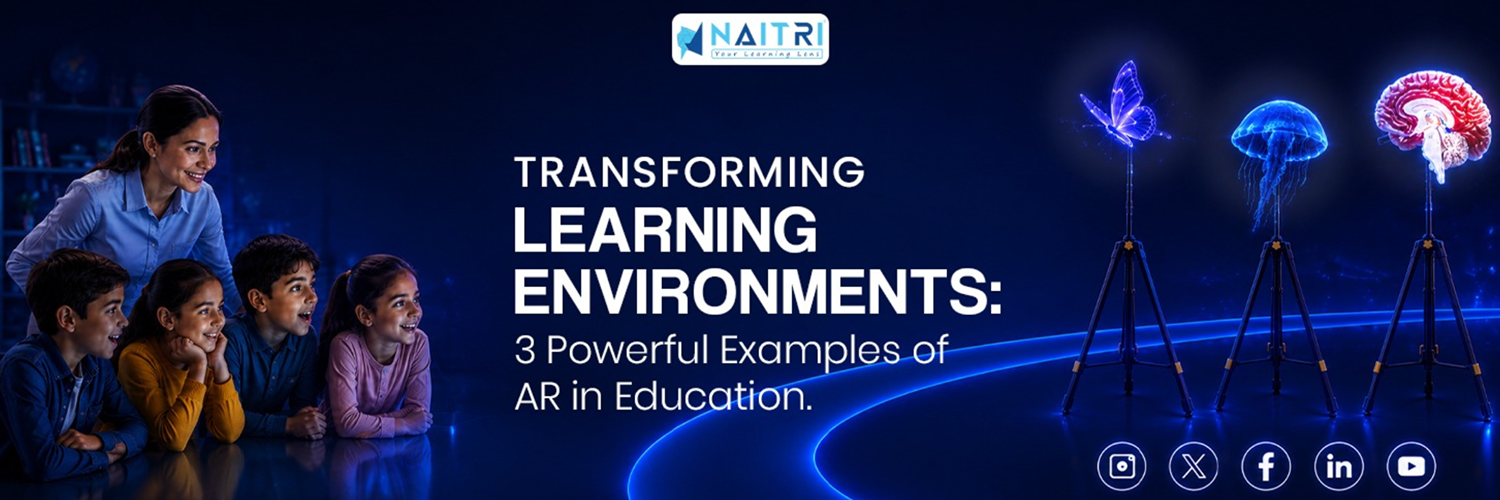
Let's look at three powerful ways AR is transforming learning environments today.
- Science Becomes Something Students Can Explore
Science isn't only for people with higher IQs. But it just doesn't feel like that when you read it in a textbook.
A chapter on the respiratory system often becomes a page full of labels and arrows. A lesson on the solar system turns into a list of facts that students are expected to memorize before the exam.
But what happens when students can interact with those concepts?
Through interactive Learning with AR, students may inspect a 3D model of the lungs, see how breathing works, or explore the numerous arteries of the heart from every aspect.
It's similar to the difference between reading a travel guide and actually visiting the destination. Both provide information, but one creates a far deeper understanding.
This is one of the biggest benefits of AR in Education. Students spend less time imagining a concept and more time understanding it.
Many modern AR education apps are helping make this possible by turning science into an experience rather than a memorization exercise. - Geography and History Feel Closer to Home
Teachers cannot make the students time-travel or take them to see a particular part of the country, right?
Showing a snapshot of theTaj Mahal is a good start. However, it’s impossible to fully grasp how vast it is, notice the intricate details etched into every corner, or appreciate the effort it took to construct something so spectacular.
While AR can't physically teleport students across the country, it can bring these experiences much closer.
An augmented Reality Classroom allows students to explore historical landmarks, geographical formations, and important locations in three dimensions. They can observe details, understand scale, and engage with the subject in ways that traditional learning methods often struggle to achieve.
Students become curious. And curiosity is often the starting point of meaningful learning. This is why many schools are exploring AR Learning Solutions and AR learning online platforms.
When students feel connected, they naturally become more interested. And interested students tend to remember far more than those who are simply memorizing for an exam. - Mathematics Finally Starts Making Sense
When you were finding the value of x, you'd be really frustrated at one point while learning all the formulas. Well, maths isn't always difficult because of the numbers, but the concepts feel abstract.
When a figure is drawn on the board, students see lines and angles. Then they're asked to apply formulas and solve problems.
Some understand immediately. Many do not. A good AR learning app helps bridge that gap.
Instead of looking at a flat drawing, students can view geometric figures as three-dimensional objects. They can rotate them, examine them from different perspectives, and better understand how measurements, angles, and relationships work.
This is one reason why many of the best learning apps for students are beginning to integrate augmented reality into their learning experiences.
Conclusion
When people hear about AR, they immediately think about technologies like 3D models, animations, visual effects, and so on. It's all about what technology allows students to do.
Most importantly, it helps them move from memorizing concepts to actually understanding them. A student doesn’t need to become an A-grade student only by understanding what’s written in textbooks. Education was never meant to be just about collecting facts; it was meant to help students make sense of the world around them.
Today, parents looking for the best studying apps, educators searching for effective AR Learning Solutions, and students exploring free educational apps for students are all asking the same question:
The answer may not lie in giving students more information. It may lie in helping them see information differently. And that's exactly what AR learning does.
Explore Similar Insights