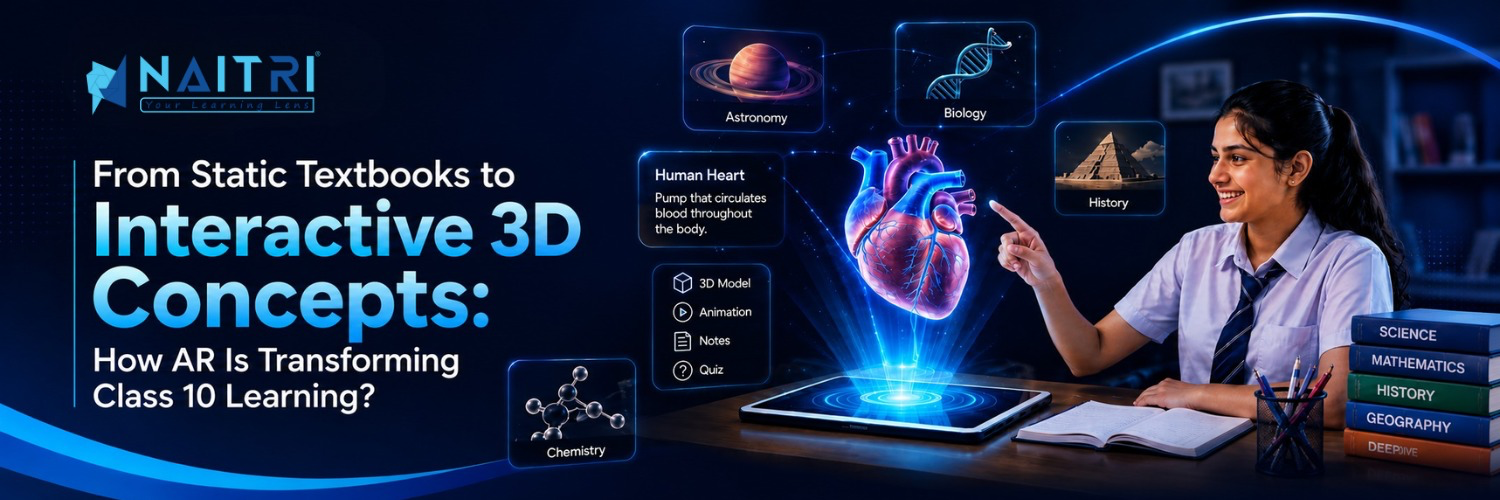
From Static Textbooks to Interactive 3D Concepts: How AR Is Transforming Class 10 Learning?
Every Class 10 student has faced this moment: staring at a flat, two-dimensional diagram of the human heart or a DNA strand, trying to imagine how it actually works in real life. For years, this has been the biggest limitation of traditional textbooks — they describe complex, three-dimensional concepts using static images on a flat page.
That’s finally changing. Augmented Reality (AR) in education is reshaping how Class 10 students learn physics, chemistry, biology, and mathematics — turning static diagrams into interactive 3D models students can see, rotate,
and explore.
Why Class 10 Students Struggle With Traditional Textbooks?
Class 10 is one of the most academically demanding years in a student’s life. It introduces conceptually heavy topics like:
- Electromagnetic induction and current electricity
- Chemical bonding and molecular structures
- Cell division and the human circulatory system
- Surface area and volume of 3D solids, and trigonometry
Most of these topics are inherently spatial or dynamic — but textbooks can only show flat, still images. This mismatch often leads to rote memorisation instead of real understanding. Students learn to reproduce a diagram for exams without actually grasping the concept behind it.
What Is AR Learning and How Does It Work?
Augmented Reality overlays interactive digital content — 3D models, animations, and simulations — onto the real world using a smartphone, tablet, or AR headset. In a classroom, a student simply points their device at a textbook page or chooses a topic, and the concept becomes a live, explorable 3D model.
Subject-Wise AR Learning in Class 10
- Biology: Visualising the Human Body in 3D
Instead of a static illustration, students can rotate a 3D model of the human eye or heart, peel back anatomical layers, and watch blood flow through chambers in real time — something no flat diagram can show.
- Biology: Visualising the Human Body in 3D
- Chemistry: Understanding Molecular Structures
Concepts like chemical bonding and molecular geometry are notoriously hard to visualise. AR lets students rotate a methane molecule or examine tetrahedral bond angles from every direction, making abstract chemistry tangible.
- Chemistry: Understanding Molecular Structures
- Physics: Watching Concepts in Motion
Topics like electromagnetic fields, light refraction, and how an electric motor works can be animated step by step. Students can pause, rewind, and replay a process instead of relying on imagination alone.
- Physics: Watching Concepts in Motion
- Mathematics: Mastering 3D Geometry
Shapes like cones, cylinders, and spheres become far easier to understand when students can manipulate them directly, rather than interpreting textbook cross-sections.
The Real Benefit: Active Learning Over Passive Memorisation
The biggest shift AR brings isn’t just visual—it’s behavioural. Traditional learning is passive: read, memorise, repeat. AR-based learning encourages active exploration, where students investigate concepts themselves instead of being told how something works.
This kind of hands-on engagement significantly improves retention. When a student manipulates a 3D model, they build a genuine mental model of the concept — one that’s far more likely to stick and transfer into solving actual board exam problems.
There’s also an important equity angle. Not every school has a fully equipped science lab. AR can give students access to interactive models and virtual simulations, even where physical lab resources are limited.
Challenges of AR Adoption in Schools
AR in education isn’t a perfect, instant fix. A few real challenges remain:
- Device access is still uneven, especially in under-resourced schools.
- Teacher training is needed to integrate AR meaningfully, not just as a gimmick.
- Quality content creation — pedagogically sound AR modules — requires real investment.
That said, as smartphones get more capable and AR education platforms mature, these barriers are steadily shrinking.
The Future of Class 10 Learning
For Class 10 students balancing foundational concepts with board exam pressure, AR offers something textbooks alone never could — the ability to see, rotate, and interact with the exact concepts they’re expected to master. A heart isn’t just a diagram anymore; it’s a beating, three-dimensional structure they can explore hands-on. A molecule isn’t just a name; it’s a shape they can hold in virtual space.
Textbooks aren’t going away — and they don’t need to. But layering AR on top of them turns passive reading into active discovery. For a generation raised on swiping, tapping, and exploring digital worlds, that shift feels less like innovation and more like common sense.
Conclusion
Augmented Reality is making education easier, visual, and far more effective for Class 10 students. It helps in understanding complex scientific concepts, retaining information longer, and preparing for board exams with genuine confidence. Instead of relying purely on memorisation, students can now focus on visual and experiential understanding. Platforms like Naitri are bringing interactive 3D AR learning directly to students, helping them grasp difficult concepts clearly and improve overall performance. So, ditch the traditional passive style of memorising books—experience the future of learning with Naitri by contacting us today.
FAQs
- Which is the best way to understand complex Class 10 concepts?
Visual and interactive 3D learning using Augmented Reality (AR) is proven to be the most effective method, as it converts flat diagram descriptions into realistic, explorable models.
- Which is the best way to understand complex Class 10 concepts?
- Does AR learning help in Class 10 board exam preparation?
Yes. By rotating and inspecting 3D concepts in Physics, Chemistry, and Biology, students develop genuine concept clarity, which helps them remember facts and score higher in board exams.
- Does AR learning help in Class 10 board exam preparation?
- Is expensive equipment like VR headsets needed for AR learning?
No, students only need a standard smartphone or tablet to run AR learning tools like Naitri.
- Is expensive equipment like VR headsets needed for AR learning?
- Can AR completely replace NCERT textbooks?
No, AR is designed to work alongside NCERT textbooks to make textbook diagrams easy to understand through 3D simulations.
- Can AR completely replace NCERT textbooks?
- Which Class 10 subjects benefit most from AR?
Science (Biology, Chemistry, Physics) and Mathematics (3D geometry and mensuration) benefit the most from AR.
Explore Similar Insights
Download Naitri App
Easy, Visual Learning — Right on Your Phone
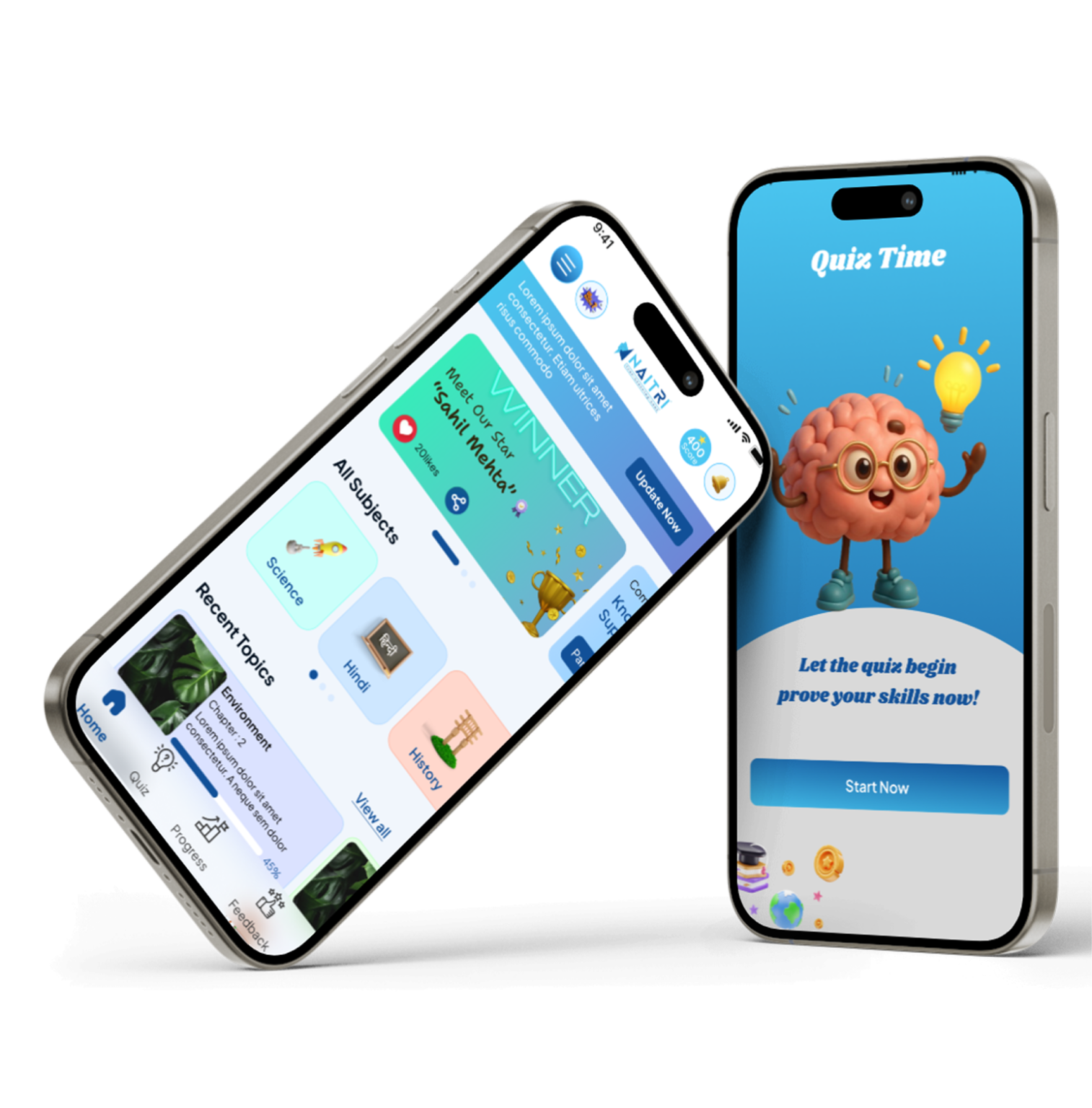
Learn with Augmented Reality! The Naitri app makes CBSE and MP Board concepts interactive and fun — even in low-resource settings. Watch lessons, complete homework, take tests, and track progress — all in one place. Anytime. Anywhere.
Available on